
Global promises won’t save nature – national action will
This piece was originally published by Constanza Torres, National Implementation and LatAm Senior Lead at Business for Nature.
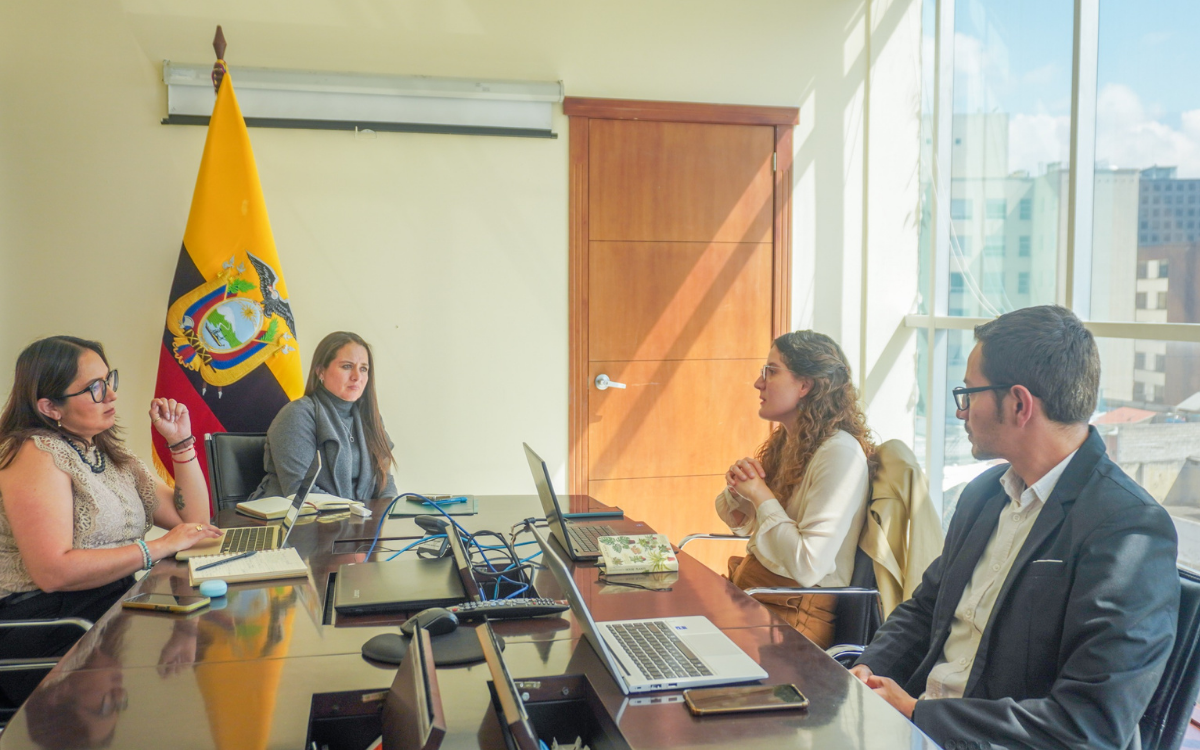
Image: Constanza meeting with Ecuador’s Minister of Environment to introduce the National Business–Government Initiatives
I often hear from business leaders and policymakers that tackling the nature and biodiversity crisis is “too complex”. But having a seat in rooms where solutions are being built, I’ve seen that complexity isn’t the barrier – the lack of a clear national roadmap is.
And for businesses, addressing this crisis is essential. Every business depends on and impacts nature. Nature loss is a real, material risk that challenges long-term economic resilience and stability. Yet today, we’re seeing a widening gap between global promises and the national “on the ground” action required to protect the natural systems our economies rely on.
The Kunming–Montreal Global Biodiversity Framework (the GBF), adopted by 196 countries, is the world’s landmark agreement to halt and reverse nature loss by 2030. Its ambition is clear. The challenge is turning that ambition into national coordination and implementation.
The ambition – implementation gap
The GBF is an important global framework, but it’s only as valuable as the action it delivers. Its implementation happens at the national and local level through policies, regulations, incentives and ultimately through the day-to-day decisions of companies and financial institutions.
Nature doesn’t recognize borders, but policy levers that shape corporate behavior overwhelmingly do. Without sustained, structured dialogue between government and business, predictable consequences follow: unclear policies, low compliance, rising tension, and global ambition that never sparks national action.
Moving from statements to implementation systems
This is exactly why Business for Nature has been investing in National Business-Government Initiatives - which help turn the GBF from a set of international targets into credible national action. These initiatives shift businesses from being a ‘spectator’ to becoming an ‘active partner’ in GBF implementation.
Our current initiatives span Africa, Asia and Latin America, supporting partnerships in countries including Chile, Ecuador, Mexico, Indonesia, Nigeria and South Africa. This is a tried and tested model, producing tangible business and government-endorsed frameworks and action plans through our previous work in countries as diverse as Malaysia and Colombia.
Advancing Business-Government dialogue in Jakarta, Indonesia
My role at Business for Nature is often about the “how” - the sometimes messy, but necessary process of getting different ministries, industry associations and businesses to agree a single action plan.
Our approach is intentionally practical. By creating a repeatable pathway, governments and businesses can move from “we should” to “we are.”
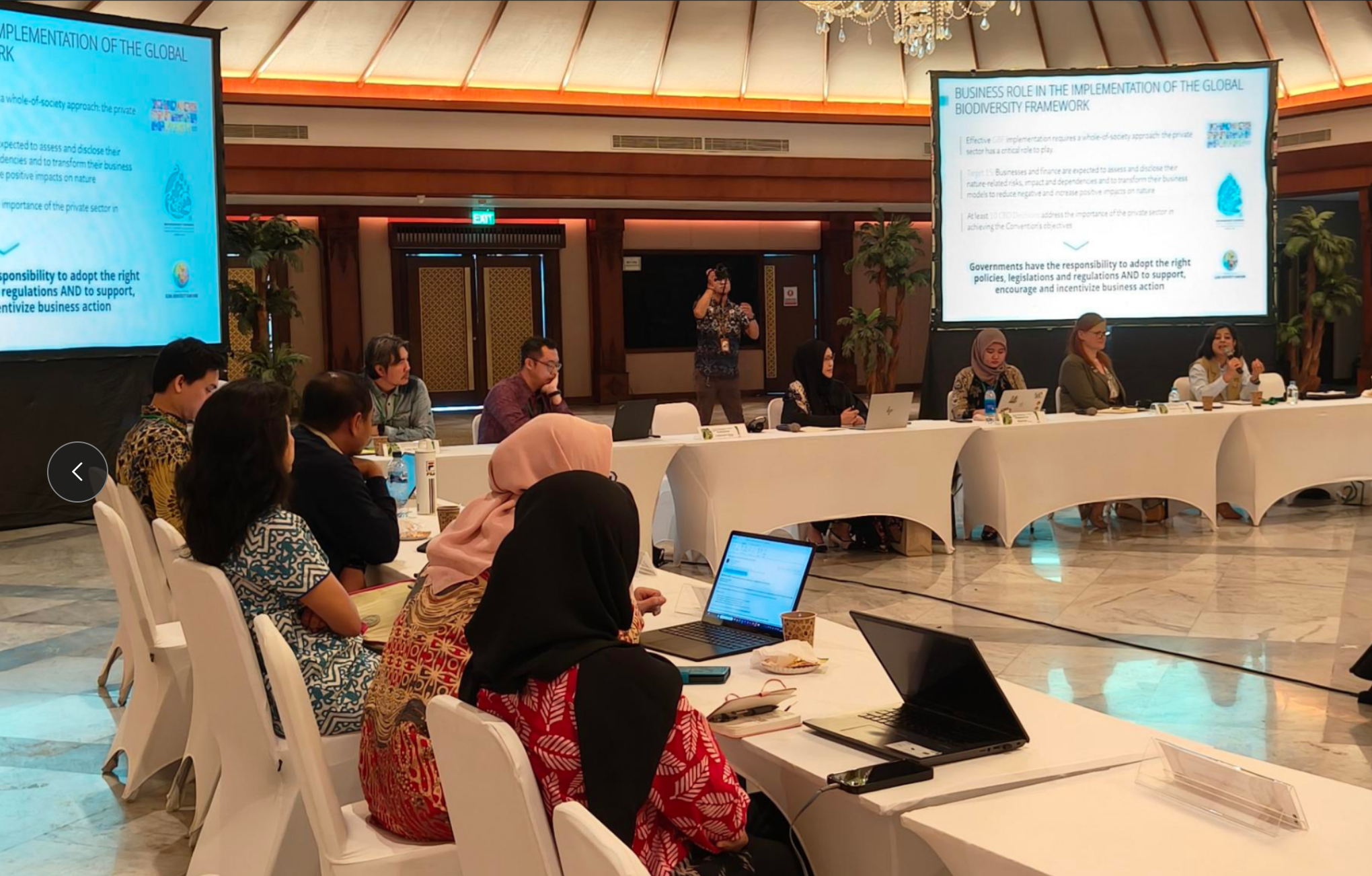
Advancing Business-Government dialogue in Jakarta, Indonesia
The common pathway: from dialogue to delivery
Across countries, the work follows a simple logic:
1. Start with a clear baseline
Map existing regulations, policies, tools and data, and which institutions are responsible for them. This helps identify gaps between the current situation and where we want to be, revealing potential pathways.
2. Bring business to the table
Establishing a Business Advisory Group allows governments to hear from leading national companies on what’s feasible, what’s missing, and what will unlock action. If done well, it becomes a coordination space that reduces policy risk and increases speed.
Nigeria provides a clear example. Last year, as part of our National Business-Government Initiatives, the Ministry of Environment, Nigeria Conservation Foundation and Natural Eco-Capital launched Nigeria’s Business Advisory Group on Biodiversity as a platform to align private sector action with national biodiversity priorities.
Inauguration of the Business Advisory Group, bringing together government, business representatives, and national business associations in Lagos, Nigeria
3. Turn dialogue into a Business Action Plan
Once that foundation is in place, then a Business Action Plan on nature can be developed - a set of agreed actions, responsibilities and timelines that clarifies what businesses are expected to do and what government will do to enable it.
Take Malaysia’s Blueprint for Accelerating Biodiversity Action or Chile’s Business Action Plan on Biodiversity – two strong, varied examples of translating ambition into national reality. In Chile’s case, the Ministry of Environment, five other ministries and 20 leading companies developed the plan over eight months of collaboration.
Every national context is different, but across countries there is a common need for radical collaboration to understand national realities and make progress on their own terms.
Effective policy that leads to action doesn’t happen by accident. Partnerships take time, trust and structure. But the benefits are immediate:
Government policies are grounded in business reality
Businesses get clarity on what’s coming, how to prepare, and where to invest
Everyone gets a shared definition of “success”
The world moves closer to achieving its nature goals
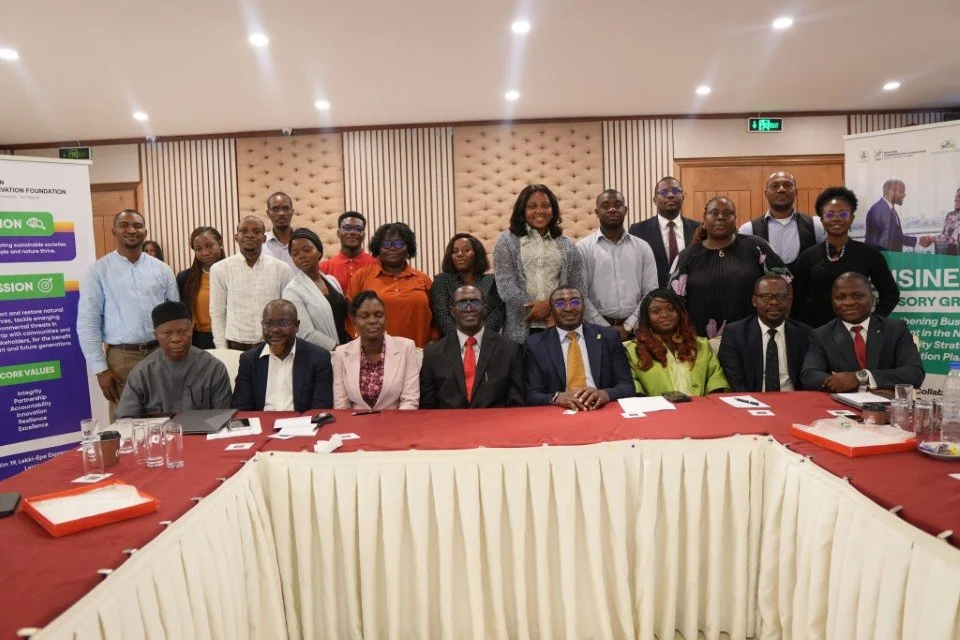
Inauguration of the Business Advisory Group, bringing together government, business representatives, and national business associations in Lagos, Nigeria
We need these national examples now more than ever
The deadline for achieving the Global Biodiversity Framework - 2030 - is approaching fast, and the next major global milestone at the UN Biodiversity COP17 in Armenia is already on the horizon. Countries will gather there to assess progress on the GBF, and they will be looking for practical and replicable national examples of implementation, not just commitments. Through Business for Nature’s work, we’ll be able to point to these examples and show it’s already happening.
Ultimately, these partnerships go beyond supporting individual countries. They are about proving that transitioning to a nature-positive economy is not only possible, but already underway.
We extend our sincere thanks to our delivery partners in each country. Their dedication and leadership at the national and local levels make this work possible.
CEMDES
Acción Empresas
Reforestamos México A.C.
Natural Eco Capital
NCF NIGERIA
Endangered Wildlife Trust
National Business Initiative
Indonesia Business Council for Sustainable Development (IBCSD)
ANDI - Asociación Nacional de Empresarios de Colombia